









By Loxion News | Johannesburg
South Africa’s fiscal recovery remains firmly on track despite escalating geopolitical tensions in the Middle East, with National Treasury confident that recent economic gains and structural reforms will withstand global shocks.
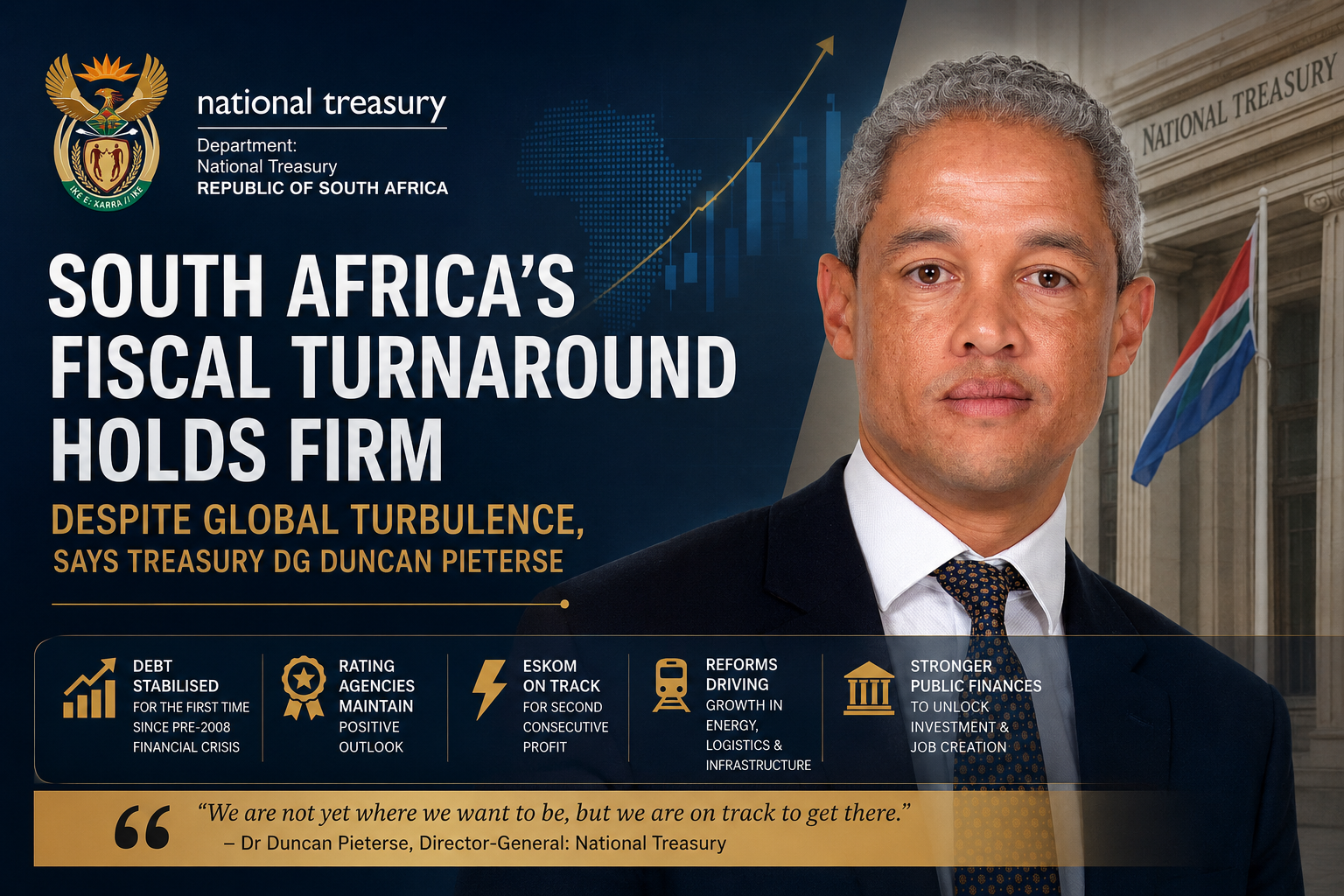
Addressing delegates at the Citi Emerging Markets Macro and Credit Conference on Monday, Director-General of the National Treasury, Dr Duncan Pieterse, painted an optimistic picture of South Africa’s economic outlook, highlighting stabilised debt levels, improving investor confidence, and strengthening state-owned enterprises.
Debt Stabilises for the First Time Since Global Financial Crisis
Pieterse revealed that South Africa has reached a historic fiscal milestone, with the country’s debt-to-GDP ratio stabilising for the first time since before the 2008 global financial crisis.
The achievement follows three consecutive years of primary budget surpluses, demonstrating government’s commitment to fiscal discipline and economic reform.
“The true test of fiscal credibility is whether a country can remain on course during times of global stress,” Pieterse told investors and financial analysts.
Despite the outbreak of war in the Middle East shortly after Finance Minister Enoch Godongwana tabled the 2026 Budget, Treasury remains confident that South Africa’s medium-term fiscal trajectory will remain intact.
International Ratings Agencies Back South Africa
In a major vote of confidence for the country’s economic reforms, both Moody’s and S&P Global Ratings recently maintained positive outlooks on South Africa.
Moody’s upgraded the country’s outlook to positive, while S&P reaffirmed its positive outlook following a ratings upgrade in late 2025.
According to Pieterse, South Africa is currently the only G20 nation with a positive outlook from Moody’s and one of only two G20 countries receiving a positive outlook from S&P.
The agencies cited improved fiscal performance, declining debt levels and ongoing structural reforms as key reasons for their optimism.
Revenue Collection Beats Expectations
Treasury reported stronger-than-expected fiscal outcomes during the previous financial year.
Government recorded a primary surplus of 1.1%, surpassing the 0.9% forecast presented in the February Budget. Tax and non-tax revenues also exceeded projections, while expenditure remained below budgeted levels.
The main budget deficit narrowed to 4.3%, outperforming Treasury’s estimate of 4.6%.
Monthly revenue figures for April 2026 also indicate continued momentum, with tax collections exceeding Budget projections by R5.9 billion.
Fuel Levy Relief Won’t Derail Fiscal Plans
To cushion consumers against rising fuel prices triggered by the Middle East conflict, government introduced temporary fuel levy relief from April to June.
The intervention is expected to cost R17.2 billion but will be fully funded through previous fiscal outperformance, ensuring that the measure remains fiscally neutral.
Treasury has further indicated that any future relief measures introduced by government departments must be accommodated within existing budgets.
Eskom and Transnet Show Signs of Recovery
Pieterse highlighted significant improvements at key state-owned enterprises, particularly Eskom and Transnet.
Eskom is expected to post its second consecutive annual profit after recording R16 billion in profit during 2025 and R24.3 billion during the first half of 2026.
South Africa has now gone more than 365 days without national load shedding, marking one of the most significant energy milestones in recent history.
Meanwhile, although Transnet remains loss-making, its financial position is improving as freight volumes recover and private sector participation expands across logistics corridors.
Treasury believes the improved financial health of both entities substantially reduces the risk of future government bailouts.
Structural Reforms Driving Growth
Treasury credits much of South Africa’s improving outlook to ongoing structural reforms in energy, logistics and infrastructure.
More than 19 gigawatts of new electricity generation capacity has already been registered, while an additional 24 gigawatts is progressing through grid connection processes.
Government is simultaneously advancing electricity market reforms aimed at increasing competition and reducing long-term energy costs.
In logistics, private operators are entering rail freight corridors, while major port reforms are beginning to yield positive results.
The Durban Container Terminal concession, which became operational earlier this year, has already shown encouraging improvements in efficiency.
Infrastructure Spending Becomes Top Priority
A major shift in government spending priorities is now underway, with infrastructure emerging as the fastest-growing category of expenditure.
Infrastructure investment is expected to grow by nearly 10% annually over the medium term, significantly outpacing overall government spending growth.
Key projects include:
- R23.1 billion for commuter rail signalling upgrades through PRASA.
- R7.4 billion additional operational support for rail services.
- R5.7 billion for rolling stock expansion.
- R11.2 billion investment in Transnet freight corridors.
- R54 billion allocated to municipal trading services reform.
Treasury also successfully launched its first Infrastructure Bond in December 2025, raising R11.8 billion to support future infrastructure development.
Municipal Reforms Target Service Delivery Crisis
With local government elections scheduled for November, Treasury announced a more interventionist approach toward financially distressed municipalities.
Government is rolling out the Metro Trading Services Reform programme to ensure revenue generated from electricity, water and refuse collection is reinvested into infrastructure maintenance and expansion.
Municipalities that fail to meet the conditions of Eskom debt relief agreements may face direct operational intervention.
Outlook Remains Positive
Despite ongoing global uncertainty and the economic risks associated with the Middle East conflict, Treasury remains confident that South Africa’s economic fundamentals are improving.
Pieterse concluded that fiscal consolidation, infrastructure investment and structural reforms are creating the foundations for stronger economic growth, increased investment and long-term job creation.
“We are not yet where we want to be, but we are on track to get there,” he said.